How shadows cast by inner disks launch spirals, drive accretion, and warp the outer disk
An introduction to shadow-induced warps, rendered in Blender by Shangjia Zhang. full resolution on figshare.
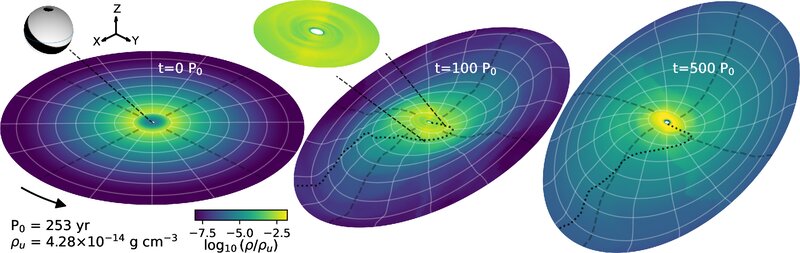
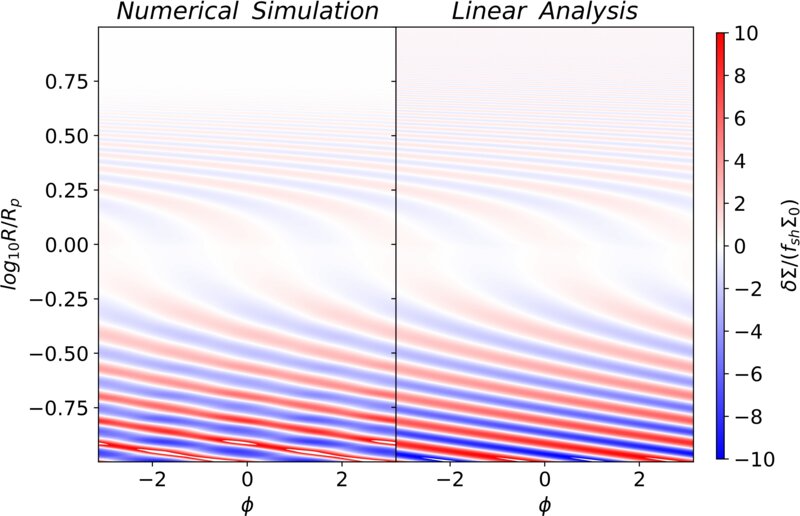
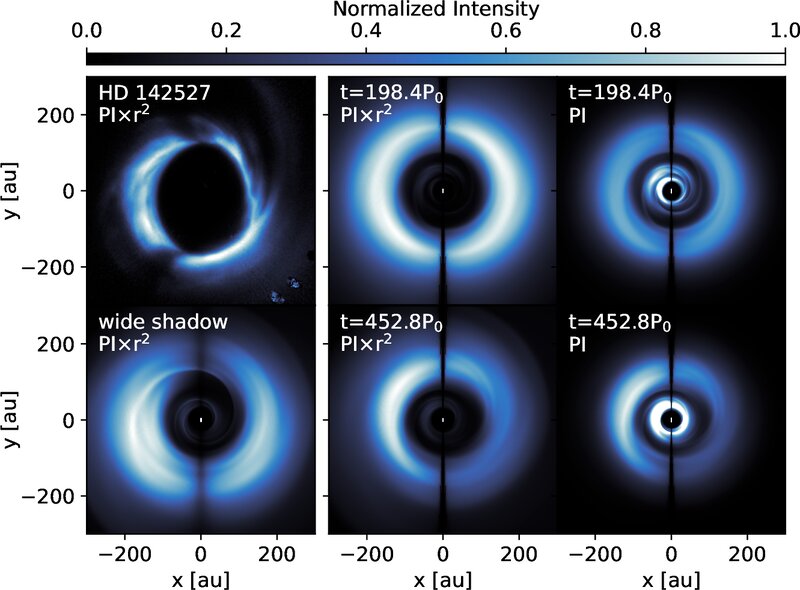
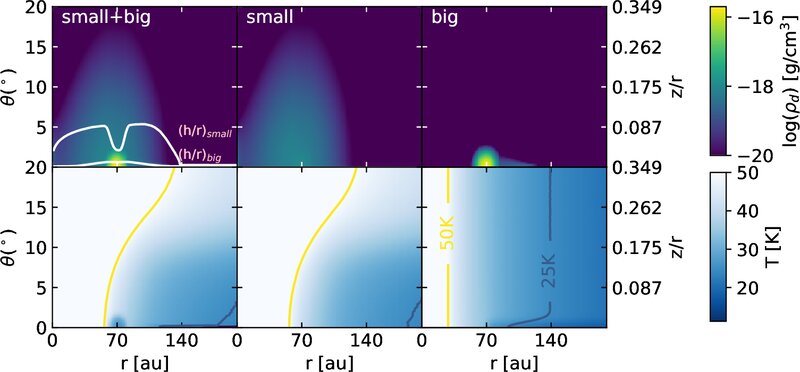
Scattered-light images from extreme adaptive optics often show dark lanes and wedges on planet-forming disks: shadows cast by material close to the star. Because these shadows change how much starlight reaches the outer disk, they are a natural experiment in disk thermodynamics. Using 3D radiation-hydrodynamical simulations with Athena++, I showed that the temperature drop in a shadow acts as an asymmetric driving force: in transition disks it launches spirals that efficiently transport mass through the cavity and resemble features seen in near-infrared images (Zhang & Zhu, 2024). Shadows cast by a misaligned inner disk can drive strong accretion and even warp the outer disk (Zhang et al., 2025). With PhD student Xiaoyi Ma, I am building a framework for how dust and gas emission respond to shadows, so that observations of shadowed disks can constrain how quickly disks cool (Zhang et al., 2026); see probing disk cooling with time-dependent features.
More broadly, temperature variations themselves can create rings and spirals (Zhang et al., 2021; Zhu et al., 2025), which is essential to know before attributing every substructure to a planet.
Movies
Midplane density of a 3D disk illuminated with a shadow lane inclined by 30°: the outer disk warps. full resolution on figshare.
Azimuthal scan through a shadowed transition disk: density, velocities, temperature, and forces (extension of Fig. 4 in Zhang & Zhu 2024). full resolution on figshare.
Full evolution of the 3D radiation-hydrodynamical transition-disk simulation with a shadow: midplane, elevated, and vertical slices of density, temperature, and velocities. full resolution on figshare.
Recorded talk
Dynamical Effects of Shadows in Transition Disks: talk at the KITP conference Planets on Edge (2025) on shadow-induced spirals in transition disks (Zhang & Zhu 2024).
References
2026
Submitted
Thermal Response of Dust and Gas to Shadows in Protoplanetary Disks I: A Beta-Cooling Framework
@article{2024ApJ...974L..38Z,author={{Zhang}, Shangjia and {Zhu}, Zhaohuan},title={{3D Radiation-hydrodynamical Simulations of Shadows on Transition Disks}},journal={Astrophysical Journal Letters},keywords={Accretion, Protoplanetary disks, Radiative transfer, Hydrodynamical simulations, Radiative magnetohydrodynamics, 14, 1300, 1335, 767, 2009, Astrophysics - Earth and Planetary Astrophysics, Astrophysics - Astrophysics of Galaxies, Astrophysics - Solar and Stellar Astrophysics},year={2024},month=oct,volume={974},number={2},eid={L38},pages={L38},doi={10.3847/2041-8213/ad815f},archiveprefix={arXiv},primaryclass={astro-ph.EP},adsurl={https://ui.adsabs.harvard.edu/abs/2024ApJ...974L..38Z},adsnote={Provided by the SAO/NASA Astrophysics Data System},}
2021
ApJ
Self-consistent Ring Model in Protoplanetary Disks: Temperature Dips and Substructure Formation
Shangjia Zhang, Xiao Hu, Zhaohuan Zhu, and Jaehan Bae
@article{2021ApJ...923...70Z,author={{Zhang}, Shangjia and {Hu}, Xiao and {Zhu}, Zhaohuan and {Bae}, Jaehan},title={{Self-consistent Ring Model in Protoplanetary Disks: Temperature Dips and Substructure Formation}},journal={Astrophysical Journal},keywords={1300, 1335, 1647, 1241, Astrophysics - Earth and Planetary Astrophysics, Astrophysics - Solar and Stellar Astrophysics},year={2021},month=dec,volume={923},number={1},eid={70},pages={70},doi={10.3847/1538-4357/ac2c82},archiveprefix={arXiv},primaryclass={astro-ph.EP},adsurl={https://ui.adsabs.harvard.edu/abs/2021ApJ...923...70Z},adsnote={Provided by the SAO/NASA Astrophysics Data System},}