Turbulence and kinematics from radiation hydrodynamics
The disk's thermal structure sets where the vertical shear instability operates
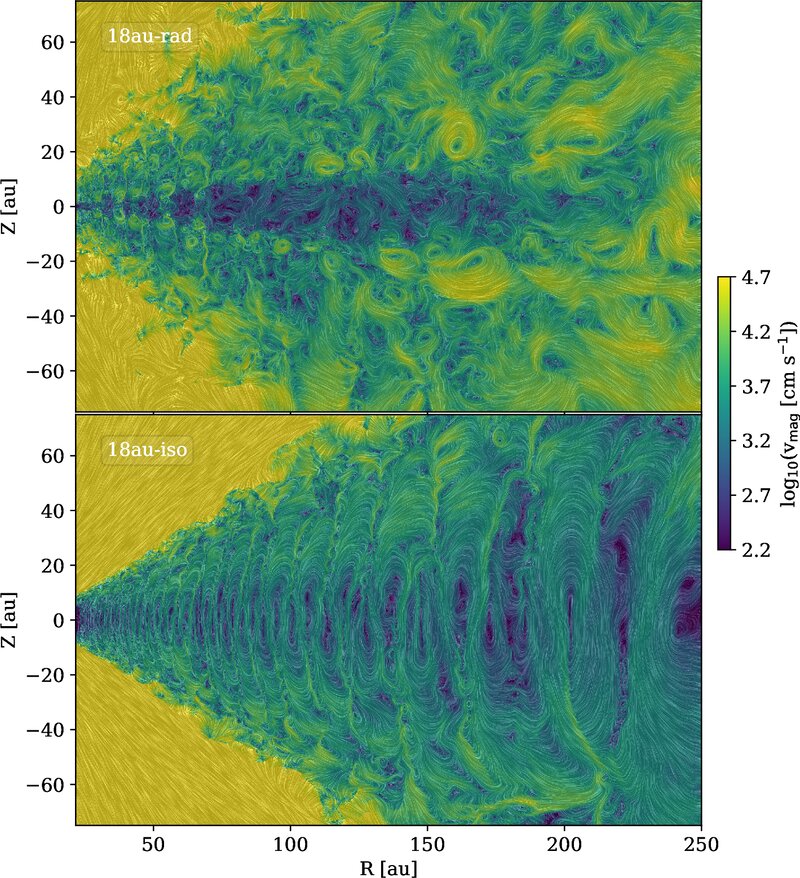
Gas motions in disks are now measured with ALMA to a precision of tens of meters per second, but interpreting them requires knowing where the disk can sustain turbulence. The vertical shear instability (VSI) depends sensitively on how fast the gas can cool, which in turn depends on the dust and the stellar irradiation. Using stellar-irradiated radiation-hydrodynamical simulations, I showed that the disk’s thermal structure determines its kinematics: a superheated atmosphere above a cool, slowly cooling midplane suppresses VSI in the midplane while the surface layers become strongly turbulent, driving fast flows near the stellar irradiation surface (Zhang et al., 2024).
I continue this program with collaborators and students, extending the radiation transport to frequency-dependent absorption and scattering opacities (Baronett et al., 2026) and coupling it to dust coagulation and settling to explain the morphologies of mature (Class II) disks (Pfeil et al., 2026).
Movies
Line integral convolution of the flow in a vertically isothermal VSI simulation.
The same in a radiation-hydrodynamical simulation with stellar irradiation.
Flow structure of the vertical shear instability visualized with line integral convolution. full resolution on figshare.
Recorded talks
Talk at the Harvard ITC Luncheon (September 2023) on how thermal structure shapes the vertical shear instability (Zhang, Zhu & Jiang 2024).
Probing Young Planet Population with 3D Self-Consistent Thermodynamics: University of Arizona Origins Seminar (2023), covering DSHARP planet inference, machine learning (PGNets), and the vertical shear instability.
References
2026
arXiv
A Framework to Model Stellar Irradiated Disks with Frequency-dependent Absorption and Scattering Opacities in Athena++
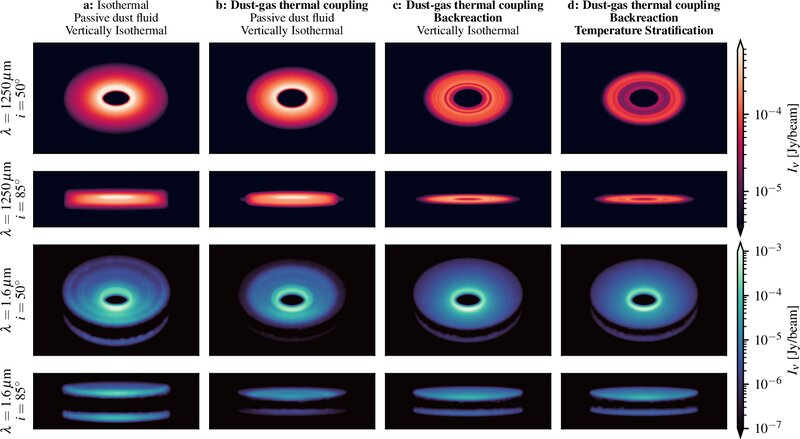
Just a Phase? Weakening Vertical Shear Instability Explains Class II Disk Morphologies: Simulations with Dust Coagulation, Sedimentation, Thermal Relaxation, and Backreaction
Thomas Pfeil, Alexandros Ziampras, Shangjia Zhang, Philip J. Armitage, and Yan-Fei Jiang