Inferring the hidden planet population from disk surveys
The 20 disks of the ALMA DSHARP Large Program at 1.25 mm (data: Andrews et al. 2018). Image: Shangjia Zhang.
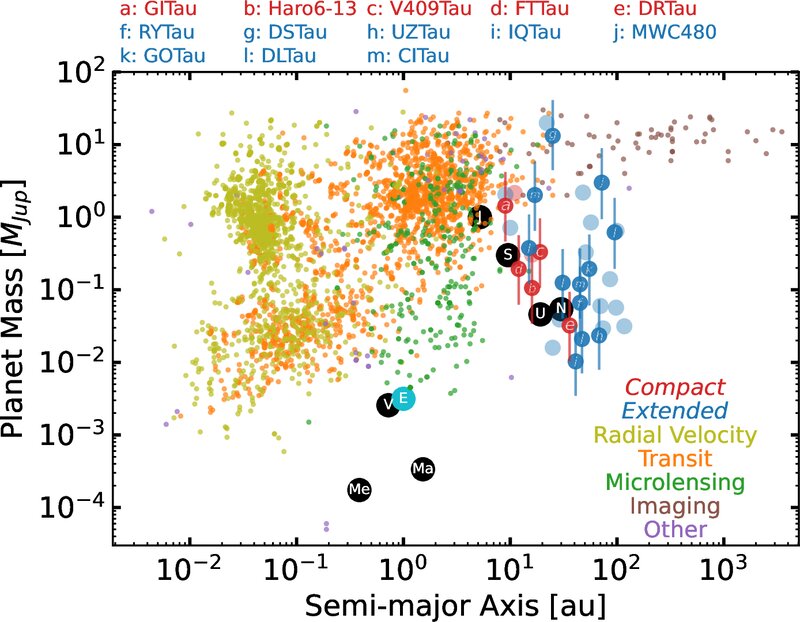
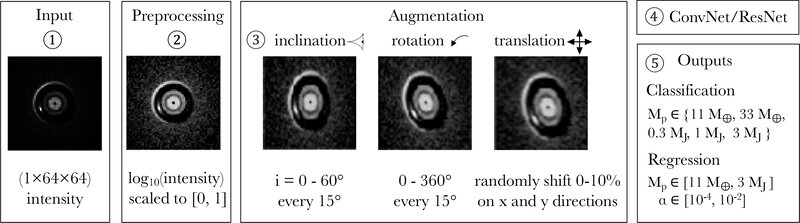
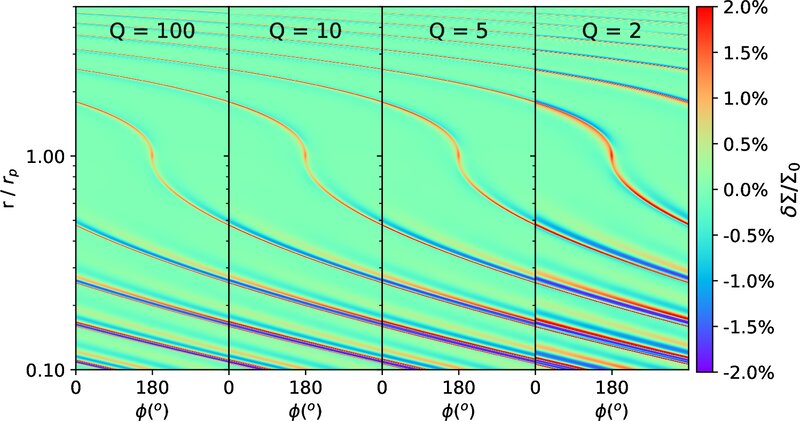
If the gaps and rings seen by ALMA are carved by planets, they reveal a population of young planets at wide orbits that no other technique can currently detect. For the DSHARP Large Program, I led the interpretation of disk substructures in terms of planet–disk interactions, using a large grid of hydrodynamical simulations with dust and radiative transfer to infer the masses of the putative planets (Zhang et al., 2018). I extended this approach to the more common, compact disks in Taurus (Zhang et al., 2023), and developed PGNets, a convolutional neural network that predicts planet masses directly from continuum images (Zhang et al., 2022). I also study how disk physics such as self-gravity and radiative cooling changes the gaps and spirals a planet produces (Zhang & Zhu, 2020).
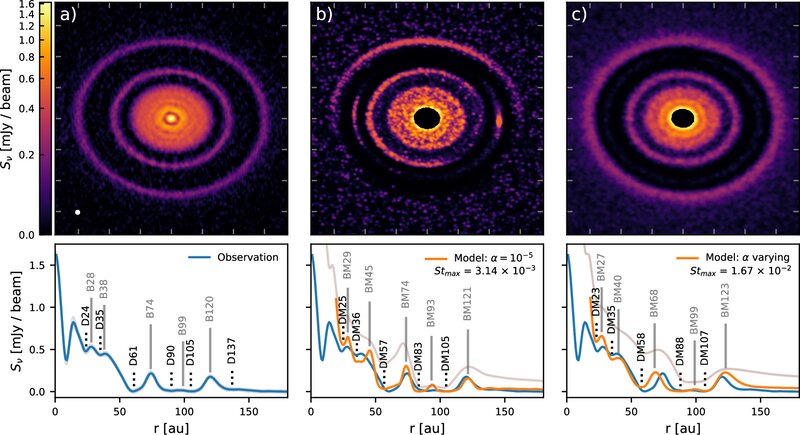
Reproducing AS 209 with a single planet: one planet (Mp/M* = 0.1 MJ/M☉) at 99 au opens multiple gaps in the gas, small dust, and big dust, producing the multiple rings and gaps seen in the 1.3 mm continuum. This is the simulation in panel (c) of Fig. 19 in Zhang et al. (2018, DSHARP VII).
AS 209 observed by ALMA (a) compared with synthetic images from single-planet simulations (b, c); the bottom row compares the radial intensity profiles. Fig. 19 of Zhang et al. (2018, DSHARP VII).
Recorded talk
Probing Young Planet Population with 3D Self-Consistent Thermodynamics: University of Arizona Origins Seminar (2023), covering DSHARP planet inference, machine learning (PGNets), and the vertical shear instability.
References
2023
ApJ
Substructures in Compact Disks of the Taurus Star-forming Region
Shangjia Zhang, Matt Kalscheur, Feng Long, Ke Zhang, Deryl E. Long, and 3 more authors
@article{2023ApJ...952..108Z,author={{Zhang}, Shangjia and {Kalscheur}, Matt and {Long}, Feng and {Zhang}, Ke and {Long}, Deryl E. and {Bergin}, Edwin A. and {Zhu}, Zhaohuan and {Trapman}, Leon},title={{Substructures in Compact Disks of the Taurus Star-forming Region}},journal={Astrophysical Journal},keywords={Protoplanetary disks, Planetary-disk interactions, Exoplanet systems, 1300, 2204, 484, Astrophysics - Earth and Planetary Astrophysics, Astrophysics - Astrophysics of Galaxies, Astrophysics - Solar and Stellar Astrophysics},year={2023},month=aug,volume={952},number={2},eid={108},pages={108},doi={10.3847/1538-4357/acd334},archiveprefix={arXiv},primaryclass={astro-ph.EP},adsurl={https://ui.adsabs.harvard.edu/abs/2023ApJ...952..108Z},adsnote={Provided by the SAO/NASA Astrophysics Data System},}
2022
MNRAS
PGNets: planet mass prediction using convolutional neural networks for radio continuum observations of protoplanetary discs
@article{2022MNRAS.510.4473Z,author={{Zhang}, Shangjia and {Zhu}, Zhaohuan and {Kang}, Mingon},title={{PGNets: planet mass prediction using convolutional neural networks for radio continuum observations of protoplanetary discs}},journal={Monthly Notices of the Royal Astronomical Society},keywords={hydrodynamics, waves, planet-disc interactions, protoplanetary discs, Astrophysics - Earth and Planetary Astrophysics, Astrophysics - Instrumentation and Methods for Astrophysics, Astrophysics - Solar and Stellar Astrophysics, Computer Science - Machine Learning},year={2022},month=mar,volume={510},number={3},pages={4473-4484},doi={10.1093/mnras/stab3502},archiveprefix={arXiv},primaryclass={astro-ph.EP},adsurl={https://ui.adsabs.harvard.edu/abs/2022MNRAS.510.4473Z},adsnote={Provided by the SAO/NASA Astrophysics Data System},}
2020
MNRAS
The effects of disc self-gravity and radiative cooling on the formation of gaps and spirals by young planets
@article{2020MNRAS.493.2287Z,author={{Zhang}, Shangjia and {Zhu}, Zhaohuan},title={{The effects of disc self-gravity and radiative cooling on the formation of gaps and spirals by young planets}},journal={Monthly Notices of the Royal Astronomical Society},keywords={hydrodynamics, waves, planet-disc interactions, protoplanetary discs, Astrophysics - Earth and Planetary Astrophysics, Astrophysics - Astrophysics of Galaxies, Astrophysics - Solar and Stellar Astrophysics},year={2020},month=apr,volume={493},number={2},pages={2287-2305},doi={10.1093/mnras/staa404},archiveprefix={arXiv},primaryclass={astro-ph.EP},adsurl={https://ui.adsabs.harvard.edu/abs/2020MNRAS.493.2287Z},adsnote={Provided by the SAO/NASA Astrophysics Data System},}
2018
ApJL
The Disk Substructures at High Angular Resolution Project (DSHARP). VII. The Planet-Disk Interactions Interpretation
Shangjia Zhang, Zhaohuan Zhu, Jane Huang, Viviana V. Guzmán, Sean M. Andrews, and 10 more authors
The Disk Substructures at High Angular Resolution Project (DSHARP) provides a large sample of protoplanetary disks with substructures that could be induced by young forming planets. To explore the properties of planets that may be responsible for these substructures, we systematically carry out a grid of 2D hydrodynamical simulations, including both gas and dust components. We present the resulting gas structures, including the relationship between the planet mass, as well as (1) the gaseous gap depth/width and (2) the sub/super-Keplerian motion across the gap. We then compute dust continuum intensity maps at the frequency of the DSHARP observations. We provide the relationship between the planet mass, as well as (1) the depth/width of the gaps at millimeter intensity maps, (2) the gap edge ellipticity and asymmetry, and (3) the position of secondary gaps induced by the planet. With these relationships, we lay out the procedure to constrain the planet mass using gap properties, and study the potential planets in the DSHARP disks. We highlight the excellent agreement between observations and simulations for AS 209 and the detectability of the young solar system analog. Finally, under the assumption that the detected gaps are induced by young planets, we characterize the young planet population in the planet mass–semimajor axis diagram. We find that the occurrence rate for >5 MJ planets beyond 5–10 au is consistent with direct imaging constraints. Disk substructures allow us to probe a wide-orbit planet population (Neptune to Jupiter mass planets beyond 10 au) that is not accessible to other planet searching techniques.
@article{2018ApJ...869L..47Z,author={Zhang, Shangjia and Zhu, Zhaohuan and Huang, Jane and Guzmán, Viviana V. and Andrews, Sean M. and Birnstiel, Tilman and Dullemond, Cornelis P. and Carpenter, John M. and Isella, Andrea and Pérez, Laura M. and Benisty, Myriam and Wilner, David J. and Baruteau, Clément and Bai, Xue-Ning and Ricci, Luca},title={{The Disk Substructures at High Angular Resolution Project (DSHARP). VII. The Planet-Disk Interactions Interpretation}},journal={Astrophysical Journal Letters},keywords={hydrodynamics, planet{\textendash}disk interactions, planets and satellites: detection, planets and satellites: formation, protoplanetary disks, submillimeter: planetary systems, Astrophysics - Earth and Planetary Astrophysics, Astrophysics - Solar and Stellar Astrophysics},year={2018},month=dec,volume={869},number={2},eid={L47},pages={L47},doi={10.3847/2041-8213/aaf744},archiveprefix={arXiv},primaryclass={astro-ph.EP},adsurl={https://ui.adsabs.harvard.edu/abs/2018ApJ...869L..47Z},adsnote={Provided by the SAO/NASA Astrophysics Data System},publisher={The American Astronomical Society},}