Dust properties from multi-wavelength observations
Measuring dust size and porosity with continuum and polarization
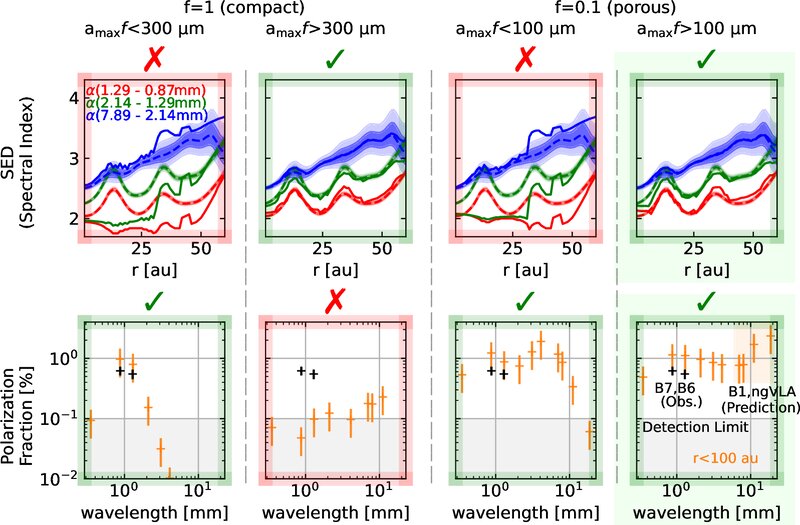
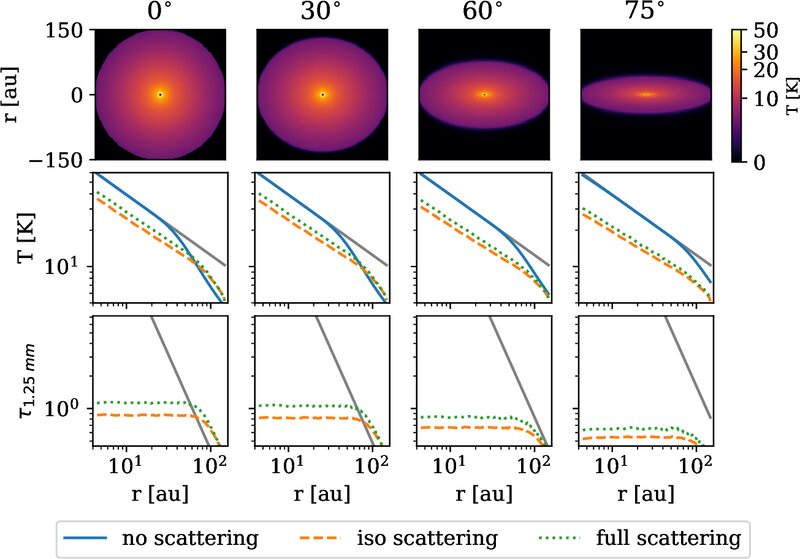
Dust grains are both the building blocks of planets and the main source of opacity in disks, so their size and structure set what we see and how the disk heats and cools. We showed that dust scattering reduces the emission from optically thick regions, so an optically thick disk can be misidentified as optically thin, with direct consequences for disk dust masses (Zhu et al., 2019). Grain sizes inferred from millimeter continuum and from polarization disagree by an order of magnitude; I showed that porous grains, like those found in Solar System small bodies, can help reconcile the two in the HL Tau disk (Zhang et al., 2023), and with collaborators studied the role of differential dust settling (Ueda et al., 2021).